What is the best and most common data collection?
What is the best and most common data collection?
The most common way to collect primary data is through surveys and interviews. Surveying is the process of collecting data through a questionnaire that asks a range of individuals the same questions related to their characteristics, attributes, how they live or their opinions.
The most common way to collect primary data is through surveys and interviews. Surveying is the process of collecting data through a questionnaire that asks a range of individuals the same questions related to their characteristics, attributes, how they live or their opinions. Interviewing, on the other hand, involves researchers seeking open-ended answers related to a number of questions, topic areas or themes.
These methods put you, as the researcher, in charge. Not only do you get to ask what you want, when you want, you also get to ask it how you want – you get to choose the wording, the order, the prompts, the probes.
Observation studies, a systematic method of data collection that relies on a researcher’s ability to gather data through his or her senses, are similar in that you set up the protocols for data collection – you decide what you will observe, when you will observe it, what you will record as ‘data’. In all three approaches, data collection is directed with some precision towards your research question, hypothesis, aims and objectives, and this has real appeal. The data collected is not superfluous but is, in fact, custom-built for your research project.
But there are some challenges associated with the collection of primary data. For one, it is a lot of work. Whether it be surveys, interviews or observation studies, it is not easy to design your own research protocols. Survey instruments are notoriously difficult to get right. Getting through a series of interviews and thoughtfully analysing them can be an exercise in frustration. And observation studies can be complex and leave you with a pile of messy data. There are also a host of ethical issues that you will need to work through to ensure you do no harm to your respondents though your research processes.
Primary data collection is also time-consuming, often expensive and doesn’t always go to plan. Getting enough survey respondents within your timeframe, racing around different parts of the city or state to conduct an interview, and the prolonged engagement that observation sometimes demands – all those need to be factored into the research design decision-making process.
If you can overcome these challenges, however, there can be great rewards. You have data expressly generated for your own research purposes, which can give you insights not available if you had used a pre-existing data set.
 Data is a collection of facts, figures, objects, symbols, and events gathered from different sources. Organizations collect data with various data collection methods to make better decisions. Without data, it would be difficult for organizations to make appropriate decisions, so data is collected from different audiences at various points in time.
For instance, an organization must collect data on product demand, customer preferences, and competitors before launching a new product. If data is not collected beforehand, the organization’s newly launched product may fail for many reasons, such as less demand and inability to meet customer needs.
Although data is a valuable asset for every organization, it does not serve any purpose until analyzed or processed to get the desired results.
Data is a collection of facts, figures, objects, symbols, and events gathered from different sources. Organizations collect data with various data collection methods to make better decisions. Without data, it would be difficult for organizations to make appropriate decisions, so data is collected from different audiences at various points in time.
For instance, an organization must collect data on product demand, customer preferences, and competitors before launching a new product. If data is not collected beforehand, the organization’s newly launched product may fail for many reasons, such as less demand and inability to meet customer needs.
Although data is a valuable asset for every organization, it does not serve any purpose until analyzed or processed to get the desired results.
What are Data Collection Methods?
Data collection methods are techniques and procedures used to gather information for research purposes. These methods can range from simple self-reported surveys to more complex experiments and can involve either quantitative or qualitative approaches to data gathering. Some common data collection methods include surveys, interviews, observations, focus groups, experiments, and secondary data analysis. The data collected through these methods can then be analyzed and used to support or refute research hypotheses and draw conclusions about the study’s subject matter.Importance of Data Collection Methods
Data collection methods play a crucial role in the research process as they determine the quality and accuracy of the data collected. Here are some mejor importance of data collection methods.- Determines the quality and accuracy of collected data.
- Ensures that the data is relevant, valid, and reliable.
- Helps reduce bias and increase the representativeness of the sample.
- Essential for making informed decisions and accurate conclusions.
- Facilitates achievement of research objectives by providing accurate data.
- Supports the validity and reliability of research findings.
Types of Data Collection Methods
The choice of data collection method depends on the research question being addressed, the type of data needed, and the resources and time available. You can categorize data collection methods into primary methods of data collection and secondary methods of data collection.Primary Data Collection Methods
Primary data is collected from first-hand experience and is not used in the past. The data gathered by primary data collection methods are specific to the research’s motive and highly accurate. Primary data collection methods can be divided into two categories: quantitative methods and qualitative methods.Quantitative Methods:
Quantitative techniques for market research and demand forecasting usually use statistical tools. In these techniques, demand is forecasted based on historical data. These methods of primary data collection are generally used to make long-term forecasts. Statistical analysis methods are highly reliable as subjectivity is minimal in these methods.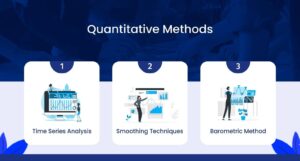 Time Series Analysis: The term time series refers to a sequential order of values of a variable, known as a trend, at equal time intervals. Using patterns, an organization can predict the demand for its products and services for the projected time.
Smoothing Techniques: In cases where the time series lacks significant trends, smoothing techniques can be used. They eliminate a random variation from the historical demand. It helps in identifying patterns and demand levels to estimate future demand. The most common methods used in smoothing demand forecasting techniques are the simple moving average method and the weighted moving average method.
Barometric Method: Also known as the leading indicators approach, researchers use this method to speculate future trends based on current developments. When the past events are considered to predict future events, they act as leading indicators.
Time Series Analysis: The term time series refers to a sequential order of values of a variable, known as a trend, at equal time intervals. Using patterns, an organization can predict the demand for its products and services for the projected time.
Smoothing Techniques: In cases where the time series lacks significant trends, smoothing techniques can be used. They eliminate a random variation from the historical demand. It helps in identifying patterns and demand levels to estimate future demand. The most common methods used in smoothing demand forecasting techniques are the simple moving average method and the weighted moving average method.
Barometric Method: Also known as the leading indicators approach, researchers use this method to speculate future trends based on current developments. When the past events are considered to predict future events, they act as leading indicators.
Comments
Post a Comment